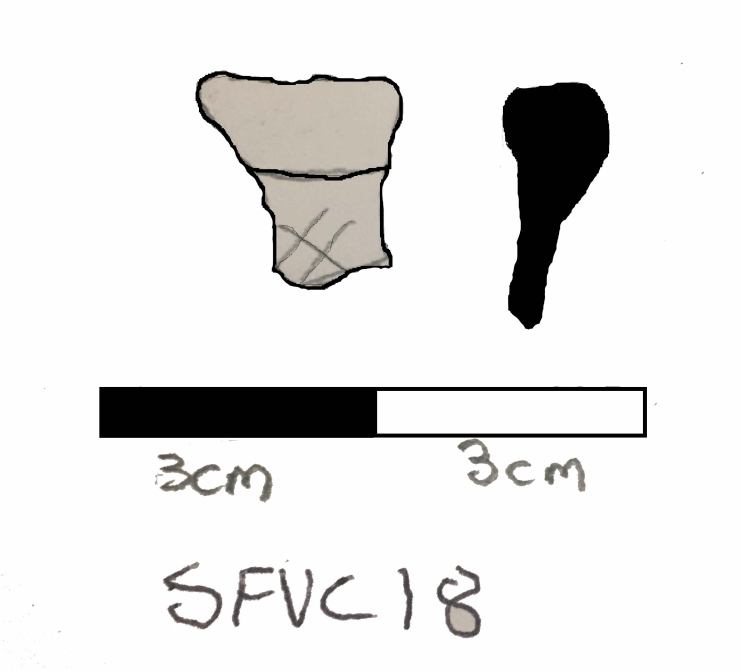
This is a drawing of a shard of 17th Century salt glazed stoneware from the Sherwood Forest Nature Reserve Visitors Centre which was closed in 2018.
Salt glazed stoneware was introduced to England in the second part of the 17th Century and is often used for jars and cups. The external side of this example has been marked with a checked pattern before firing.
This is the outer side of it, which shows markings that have been scarred into the pot before firing. It also shows the profile of the pot. I chose not to draw the inside of the pot as it has no distinguishable markings.
These drawing are useful as it allows the artifact to be added to the written record and interpretation of the artifact to be added by the illustrator.
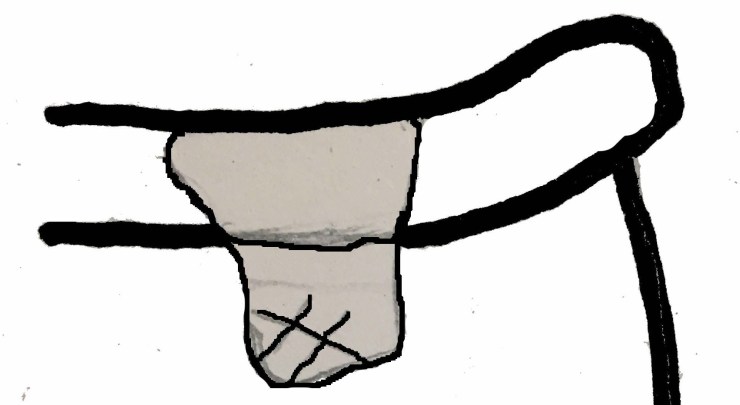
This second image shows how the shard would relate to the rest of the pot. This is just a sketch and is not done to scale.
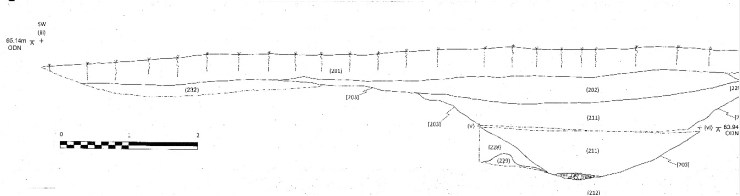
This is an archaeological section drawing. This are useful for adding interpretation to the section by defining where there is a change in context without the distortion that a camera can add. If you want to see in in more detail click on the image below.
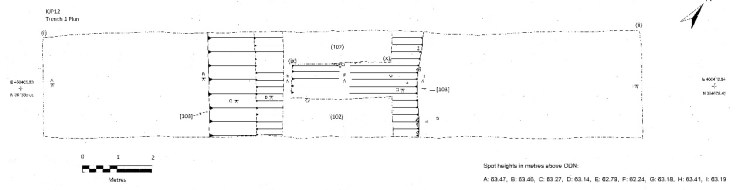
This image is an archaeological drawing of a plan. Click on the image for more details.
Bibliography
Adkins, L. and Adkins, R. 1989. Archaeological illustration, Cambridge; New York: Cambridge University Press. (Chapter 1 and Chapter 8)
Morgan, C., & Wright, H. (2018). Pencils and Pixels: Drawing and Digital Media in Archaeological Field Recording. Journal of Field Archaeology, 43(2), 136–151.
Piggott, S. 1965. Archaeological Draughtsmanship: Principles and Practice Part I: Principles and Retrospect. Antiquity, 39: 165-176.
 Pub Archaeology